
Inbound marketing is the new standard of marketing today. It has not only been adopted but has also scaled over the past few years. In this environment it requires broader and sharper attention when it comes to creating and executing marketing strategies for your business.
Achieving lead generation through inbound marketing is not enough. You must have a lead nurturing strategy that applies to the almost 90% of those leads that have not made their purchase or closed the deal with you immediately. Choosing the right lead nurturing strategy can have a huge impact on your overall marketing strategy and ultimately on your business growth.
Only two years ago, lead generation, sales and lead nurturing were the top three organizational objectives for content marketers.
What is lead nurturing? It is the process of engaging a defined target group by providing relevant information at each stage of the buyer’s journey. Providing information. How can you do that and why should you do it, you may be asking? You need to provide them information on how your service or product is addressing and solving their needs. You want the prospects you have provided with lead generation efforts to turn into paying customers. You can nurture leads through targeted content, multi-channel nurturing, multiple touches, timely follow-ups and personalization. Though it might sound simple, marketers struggle with these questions, and according to some research more than half of them gave their lead nurturing programs a failing grade. Inbound marketing environments have raised the standard in the marketing industry, and you must create and execute effective strategies to gain an advantage over your competition.
Lead nurturing is just one component of the whole inbound marketing strategy. You should think about which lead nurturing tactics work best for you and your business. If you are completely new, you may be thinking about how to get started and, of course, wondering what the secret of super successful marketers is and what they do differently…
Here comes the detail: closely looking at your website, digging around to find out how to attract more traffic, how to convert leads and how to close customers. So, after all the research, we have chosen to share with you some of the most effective lead nurturing tactics.
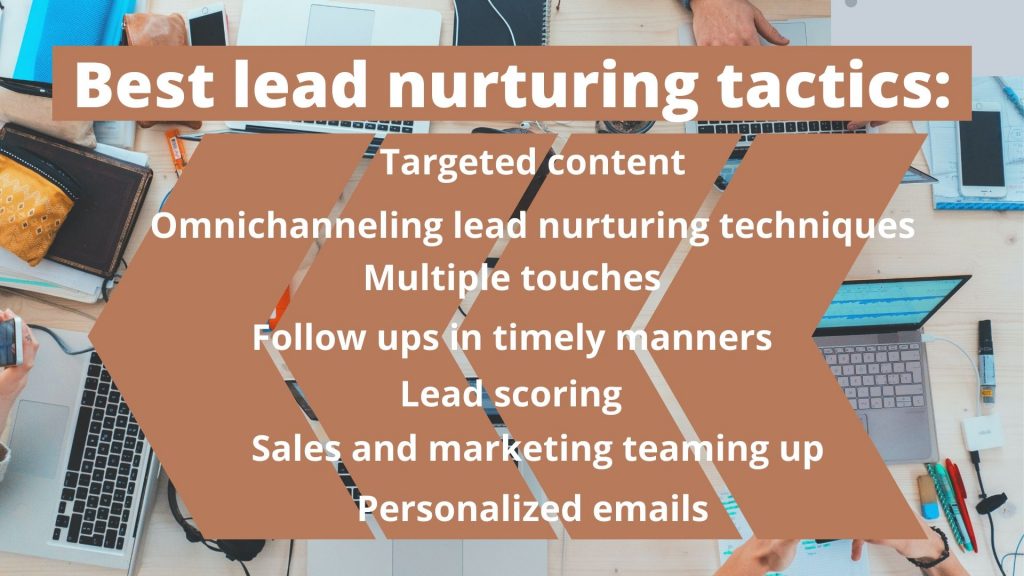
Targeted content
The most obvious tactic seems to give a headache to at least a third of B2B marketers. Targeted delivery of content can be a pain – delivering the right content, to the right people, at the right time seems to be the biggest nurturing challenge. There is no universal formula, and many times it is done on a hunch because, even with good analytics, behavioral factors can change under different circumstances. But it is worth the effort, because all research says it can significantly improve the results of your inbound marketing strategy.
Targeted content requires a good understanding of your unique buyer personas. Furthermore, you need to create an assortment of content designed to nurture each of their interests, goals, objectives and marketing triggers. Scaling it up will require an automated platform that will help you identify, segment and target your audience.
Omnichanneling lead nurturing techniques
The time when setting up an email drip campaign was enough to nurture leads is long gone. Now, you have to cover all channels if you are in the game for the long run. Doing this is not easy, and you will probably at some point need to use marketing automation platforms.
To achieve efficiency in lead nurturing, strategies commonly involve combined marketing automation – email marketing, on- and off-page optimization, social media, paid targeting, dynamic website content and direct sales outreach. Since there are plenty of tactics involved, execution requires a team that works cohesively. There are no more do-it-yourself ways.
Multiple touches
Research studies show that prospects receive ten touches from the time they enter the top of the funnel until they become closed customers. On the other hand, about half of marketers include fewer than five touches in their nurturing programs.
Lead nurturing strategies should deliver content that helps prospects progress through their buyer’s journey by addressing their common questions and concerns. Besides email tactics, you must develop a strategy for using a mix of content types, such as social media, blog posts, whitepapers, interactive calculators, quizzes and other content that will nurture your connection and interaction with your prospects.
Timely follow-ups
Immediate follow-up gives evident results. This might be your advantage over your competitors. Many businesses still fail to respond and follow up quickly enough. Research showed that less than 40% manage to respond within an hour, and less than 25% respond in less than 24 hours. Some never respond at all.
Automation will open the door for you to generate leads and reach out to a bigger number of prospects, but following up in a timely manner by email, direct message or phone call is still the best way to convert inbound leads into real opportunities. All analytics show that the conversion rate is highest with prospects who are contacted immediately after the website conversion.
Generally, inbound leads are far more effective than cold calling. The longer interaction provides more information on your prospect based on their browsing behavior and some initial information that you can enrich with a little research on where they work and what their position is within the company.
Lead scoring
Lead scoring means evaluating the prospect’s perceived value by ranking prospects against a scale. It is usually implemented in most marketing automation platforms by assigning numeric values to certain website browsing behaviors, conversion events or social media interactions. The resulting score is used to determine which leads should be followed up with by a sales representative or whether they need to be further nurtured down the funnel. Lead scoring is an effective lead nurturing tactic.
Sales and marketing teaming up
According to recent research, companies with tightly connected sales and marketing teams achieve around 35% higher customer retention rates compared to those with separated or disconnected teams. It is visible that companies with shared responsibility for lead nurturing in both marketing and sales experience a significant financial boost.
It is recommended that these shared expectations, responsibilities and goals between the marketing and sales teams be outlined in a so-called Sales and Marketing Service Level Agreement (SLA). Doing this has proven to be an effective way of having both teams hold each other accountable for converting leads and effectively nurturing them into paying customers.
This way, the best of the human potential in the company is used to contribute to lead nurturing and to identify the prospects that need to move between teams as they progress through the funnel.
The transition of prospects from the automated environment to direct one-on-one contact works best when done through careful follow-up and by identifying those who show the right level of engagement, tracked through lead scoring, page views, conversion events or sales contact.
Personalized emails
Email marketing is still the most effective tactic for lead nurturing. Personalized emails produce far better results than generic marketing. Don’t take this for granted: the latest research shows that more than 40% of consumers have switched businesses due to a lack of personalization. This fact shows the huge importance of personalization.
Personalization can be executed in many ways – triggered emails when someone downloads gated content, clicks on links in your email, or visits certain pages on your website. Behavioral triggered emails combined with the power of marketing personalization can deliver the right message to the right people.