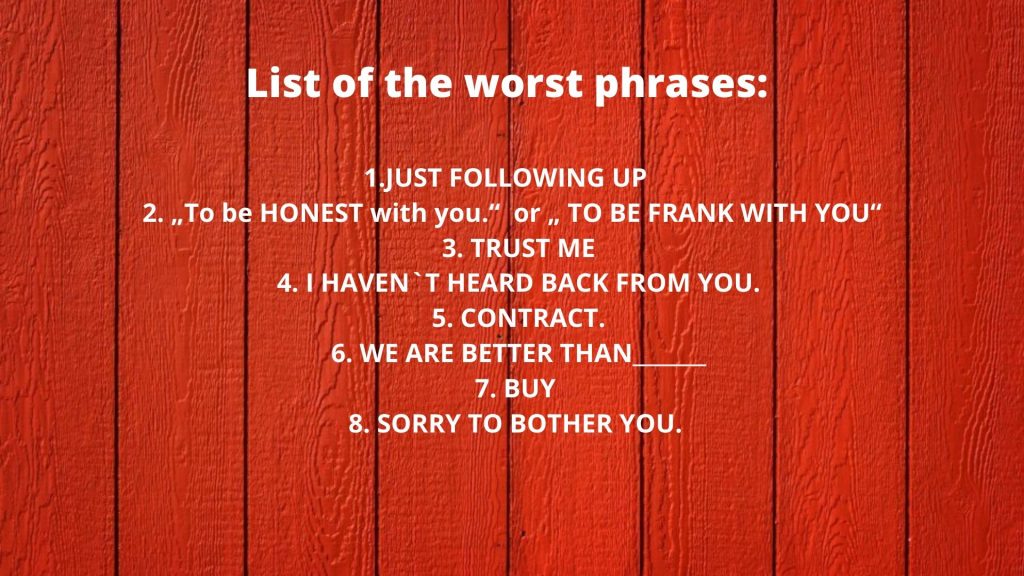
Whichever B2B channel you are using in sales, there are some words and phrases you need to avoid, simply because they carry a negative emotional charge and trigger negative reactions from your prospects. This is simply a matter of the subconscious reaction of the prospect, regardless of the field you operate in, whether you are providing a product or a service. These are the worst phrases and words you can use in your communication:
1. JUST FOLLOWING UP.
Have you been using this phrase? A lot of people use it. That is exactly the problem. It has been used by so many salespeople that it automatically triggers a defensive response. When people see it in an email or hear it, what pops up in their mind is: „Oh, I don't have time for this!“ or „Oh, you want to sell me something? What's the thing? You didn't close me last time, so here you are now following me up, ha?“
This is simply an overused phrase that has become an allergen for people. They react as if they are allergic to the words. So, don't use these words.
2. „To be HONEST with you.“ or „TO BE FRANK WITH YOU“
These phrases are among the worst to use, simply because the minute you say them, they discredit all of your former efforts to establish a direct and deeper connection with your prospect. These phrases are the fastest way to drag your communication down to a lower level, throwing off your position toward closing the sale.
„Just to be honest with you. This is the best price we can give you.“
„To be honest with you, we don't give this deal to anybody else.“
So, after hearing these phrases, the logical questions that come to your prospect's mind are: Have you not been honest with me this whole time? Have you been lying to me? Is that what this is? Have you not been upfront with me? Have you not been frank with me this whole time? Is this what this is, clearing up your misbehavior with me? Really, this whole time? The past hour or two, or maybe a few months, and NOW you are telling me, „OK, let me be honest“??? It really sounds awful, we all agree.
Don't use these phrases.
3. TRUST ME
When you write or say „Trust me“ in your sales communication, it is an instant reminder that TRUST has not yet been given. Practically, you sound like a movie character, and this is the real world. Think about it. Why do you say „Trust me“? It's because you know your prospect doesn't trust you, and now they should just because you say so? It makes no sense.
If you are trustworthy, do you have to tell people to trust you? No. Your actions speak louder than your words. Your ACTIONS will show your prospect whether they should trust you or not.
Do not use these words.
4. I HAVEN'T HEARD BACK FROM YOU.
What are you telling them with these words? Are you telling your prospect something they already know? Why are you wasting their time telling them things they know? Your prospect is perfectly aware that they haven't responded to your efforts to connect, and there surely is a reason for that. So what you are doing by using these words is, in fact, reviving the resistance they already have in their mind.
It's very simple: you haven't heard back from your prospect because they don't want to be contacted. They have been avoiding it for numerous reasons, which might be personal, or simply because you still haven't hit the right need or offered the right amount of value.
So, instead of bringing all that up again, when you contact your prospect, especially those who have not converted in the past, don't make them feel guilty, don't embarrass them, but ADD VALUE. At every touch point, in every contact with them, always offer something. Offer, offer, offer… And then, when they are ready to enter into this business relationship with you, it will be a no-brainer for them. They are on familiar ground with you, they will feel safe and ready to take the next step. You are the person who has been around for a long time, giving them offers and a set of values, and you will close your sales with a prospect who is happy to do business with you.
5. Another word: CONTRACT. That's right, CONTRACT.
Contract is the most common and very expected word, especially if you are offering services. The problem with this word is that it creates a cold feeling. In people's minds, it is associated with heavy, hard OBLIGATIONS. So when your prospect hears it, it most likely reminds them of the burden on their side. This brings the whole communication straight down.
What your prospect pictures is a 20-page document signing away his life. No, that is a very dangerous situation for him or her. So, don't use this word. A much better choice is to say AGREEMENT. Now that sounds much better, doesn't it? Contract – tension, agreement – calming. It sounds OK. Surely we can agree on something. Just agree, that is OK, it is an improvement in communication, it's not intimidating, and there is no pressure.
Or, another word with the same meaning and a much more casual sound is PAPERWORK. „How about we get the paperwork out of the way?“ See, now that sounds like a friendly discussion. No one likes paperwork, and it brings thoughts of the other side of the process, raising the question of what comes after the paperwork. And that is where the important things are, right? And everyone knows that paperwork is, in fact, signing a contract. You are signing the agreement. So, you have cleared the paperwork out of the way, and now you are free to move forward to the real exchange of value: money for service or product.
6. The last word you want to avoid is: WE ARE BETTER THAN_______… fill in the blank.
If you have entered two-way communication with your prospect, meaning you've received a response from them, a question of comparison between you and your competitor very often comes up. So the question arises: why would they choose you over them? What most salespeople do is jump in to put down their competitors by using this phrase: „We are better than____________ company ABC“, „We are better than him or her,“ and then fill the conversation with detailed comparisons: because we give better service, better products, better care for customers, better benefits, and so on.
NO. Don't do this. It paints a bad picture of you: it makes you look like someone who would say anything and everything to get the sale done, and it portrays you as a very selfish and proud person with no actual proof. What your prospect is thinking is that you are shameless. They know you want to make the sale and earn the commission, and that you are shamelessly putting other people and companies down to do it. Even though this may be true, even though you might be the better choice, even though you provide better quality, don't say it. Remember that there is a reason your prospect has entered this communication with you, and that they have not yet chosen the company to engage with. So instead of bragging like a common, uneducated salesman, try to understand their needs and problems better. Ask questions, and ask them kindly, in a respectful manner.
For example: Your prospect asks you what makes you better than your competitor. Ask if they have talked to that company. Ask what their dilemma is. Find out what is troubling their mind. Lead your prospect through their dilemmas and to their own conclusions.
There is a reason they are discussing it with you and not your competitor. It means they have not yet made their decision. Otherwise, they would have already gone with them. They have not pulled the trigger yet; they are still thinking, still looking for the solution. And they trust you enough to communicate with you, so there is no need to put your competition down. All you need to do is demonstrate that you understand their problems and that you can offer them better solutions than any of your competitors. Ask questions, don't brag.
7. One more word to avoid in sales is: BUY.
BUY. Even though people love to buy, they hate to be sold.
Buying means giving away money, right? Who wants that? No one. What instantly comes to your prospect's mind is the image of money leaving their accounts. And they really don't like that idea.
See, they want your service and your product, but you don't want to turn their mind toward the bad side of losing money; you want them focused on the good side of the benefits they will receive from this product or service.
Think of how many times it has happened to you that you wanted something, but the second you saw or heard the word „buy,“ it triggered a very loud NO in your mind. No, I don't want to spend money. No, I don't want to pay for this. Tension – loss…
Instead, try saying:
„Would you like to take this home with you?“
The answer is: „Sure“ (with a smile).
Or you may say: „Would you like to own this?“
The answer is: „Oh, sure.“
Try some other questions as well:
Would you like to take advantage of this?
Would you like to move forward?
Of course, who doesn't like to move forward? Everyone wants to move forward in life. But not buy.
8. Lastly, never use the phrase SORRY TO BOTHER YOU.
Sorry to bother you? Then why the hell are you bothering me? If you feel so sorry about it, then just don't bother me in the first place. Why are you wasting my time?
This is a very bad phrase to use, because it puts you in a lower position. The buyer is always in a better position, a position of power. So when it comes to closing sales, the salesperson, or the closer, is the one with less power. You must level this up in order to close the sale. But the minute you apologize, you are lowering your position.
You don't have to apologize for what you sell or for what you are bringing to the table. You are making an offer, and there is nothing to apologize for. You are offering them solutions, and that is a good thing, not a bad one.
Your time as a salesperson, or as a closer, is as valuable as the prospect's time. Just because they give you money doesn't mean your time is not valuable. They are only buying from you because you can solve their problem. Your product or service helps them overcome the issues they are struggling with. That's it. It's a value-for-money exchange. You are not begging; you are offering.
These are the phrases and words you should avoid in any sales or closing scenario. Of course, keep yourself updated, because time also affects which phrases and words work or should be avoided in sales scenarios, especially given the fast-changing global nature of sales. So, from time to time, check for new findings in the world of sales.